CASE STUDY / SEVEIL
FINO FENG · 2026
SEVEIL key art — Nate Marsh surrounded by flying cards and the silhouettes of VEIL & CO. executives

A corporate-horror roguelike deckbuilder — from first AI session to a playable demo, an extensible core, and the production system that built them, in three months.

I’m a game artist and art director with 15+ years across mobile and PC. For SEVEIL, I owned the creative vision and the production system — directing AI agents across engineering, tooling, localization, and testing.

1Person
3 moTo playable demo
62Cards in current demo
2Starting archetypes
1Chapter · 1 boss
LiveDemo on Steam
Late Apr 2026
First AI session · production begins
Jun 2026
Core systems playable
Jul 21
OpenAI Build Week entry
Aug 03
Demo baseline frozen · all gates green
Aug 05
Steam page & demo live
01 · The Premise

Work is combat.

VEIL & CO., the world's most celebrated century-old textile company, is hiring. A year ago your sister walked into this building and never came out. Now it's your first day.

SEVEIL turns corporate life into a roguelike deckbuilder: performance reviews, overtime requests and forwarded emails are your cards; the weekly calendar is your map. You fight colleagues, defeat them, then recruit them onto your team — spending their energy, managing their loyalty, and climbing toward executives whose boss fights are built around the way each of them rules.

Health and sanity are resources you can burn. At VEIL & CO., everything is a resource. At the table, you are your own final bargaining chip.

Solomon Graves boss fight with the complete combat arena and interface
Executive boss fight. Every executive has a story, an agenda, and a battle system built around the way they rule. Character art carries the intimidation; the UI stays in-fiction as VEIL & CO.'s workday terminal.
02 · Art Direction

The whole game is company software.

The core visual decision: the player never looks at a game UI — they look through VEIL & CO.'s internal software. Menus are personnel systems. Combat is a daily standup. Team management is a personnel archive with clearance levels and sealed files. Horror comes from restraint: surveillance chrome, archival typography, and the quiet menace of a company that logs everything.

PILLAR 01

In-fiction UI

Every screen is diegetic corporate software — clearance stamps, encrypted chat, audit trails. The interface itself is the world-building.

PILLAR 02

Character-first

Painterly, fashion-conscious portraits carry the emotional weight against noir photographic environments — warmth trapped inside a cold system.

PILLAR 03

Corporate menace

No gore, no jump scares. Dread is built from HR language, gold-on-black accents, and what the archive refuses to show you.

Combat screen — a daily standup meeting rendered as card combat against colleague Gigi
Combat as a meeting. Turn-based card combat framed as VeilChat daily standup; enemy intents read like management behavior.
Keystone card primed during a boss fight
Keystone moments. Each archetype's core policy card gets a full-screen presentation beat — the one place the quiet UI is allowed to shout.
Employee Profile screen — personnel archive showing Gigi's file, module tiers and encounter profile
The archive as a management screen. Recruited colleagues live in a personnel archive: full-body art, department records, upgradeable passives — and sealed pages you don't have clearance for yet.
03 · My Role

Creative ownership across the full pipeline.

SEVEIL is a solo project in the sense that every creative and production decision passed through one person. I ran it like a studio, where the staff happened to be AI, directing specialized agents across distinct production lines. Shipping web-first was equally deliberate: it was the fastest medium to put a playable build in front of real players and start learning.

Owned directly

Art direction · character, environment & UI design · key art · game & systems design (62 cards in the current demo; 118-card, 6+ archetype Early Access target) · narrative & world-building · production planning · Steam page & marketing copy

Directed through AI

All engineering (web + desktop builds) · rendering passes and iteration in the art pipeline · localization drafts · test automation — implemented by AI agents under my direction, review, testing, and release control. I am not a traditionally trained software engineer; I own the engineering outcome through system design, layered verification, hands-on playtesting, and release control.

04 · Directing AI as a Team

AI is the staff. Direction is human.

The interesting problem wasn't getting AI to produce — it was getting AI to produce to a quality bar, without wrecking what already worked. My answer was to manage AI agents the way an art director manages a team: written standards, scoped assignments, and hard gates.

Written constitution
A standing rulebook every AI collaborator must read before touching the project: naming rules, stop-lines, communication standards, and the principle that a passing automated test never outranks a human playtest.
Scoped work-lines
UI, mail system, boss design and story each ran on an independent line with its own branch, tag, test scope and rollback point. No big-bang refactors; no experiment ever mixed into the stable demo without explicit sign-off.
Frozen baselines
The playable demo is a frozen, verified baseline. Candidate work must pass audit, full build, silent automated tests and my own hands-on playthrough before it can touch it.
Release gates
Store configuration, review submission, page visibility and public release are four separate gates — nothing ships by accident.
Handoff memory
Every AI session ends with a handoff package — state, evidence, boundaries, next steps — so a brand-new session can resume the project without me re-explaining it. The whole studio fits on a portable drive.
Hybrid art pipeline
Hand-drawn design and sketches → AI-assisted rendering and exploration → human paint-over and a final art-direction pass. AI accelerates; it never gets the last word on quality.
INTERNAL PRODUCTION SYSTEM · RECORD 04-A USED ON THE STEAM DEMO

I built tools for the work, not just the game. As SEVEIL grew, I directed AI agents to build an internal toolchain around it. Some tools accelerated creative iteration; others protected the playable build from regressions.

Creative iteration workbenches
TOOL 01
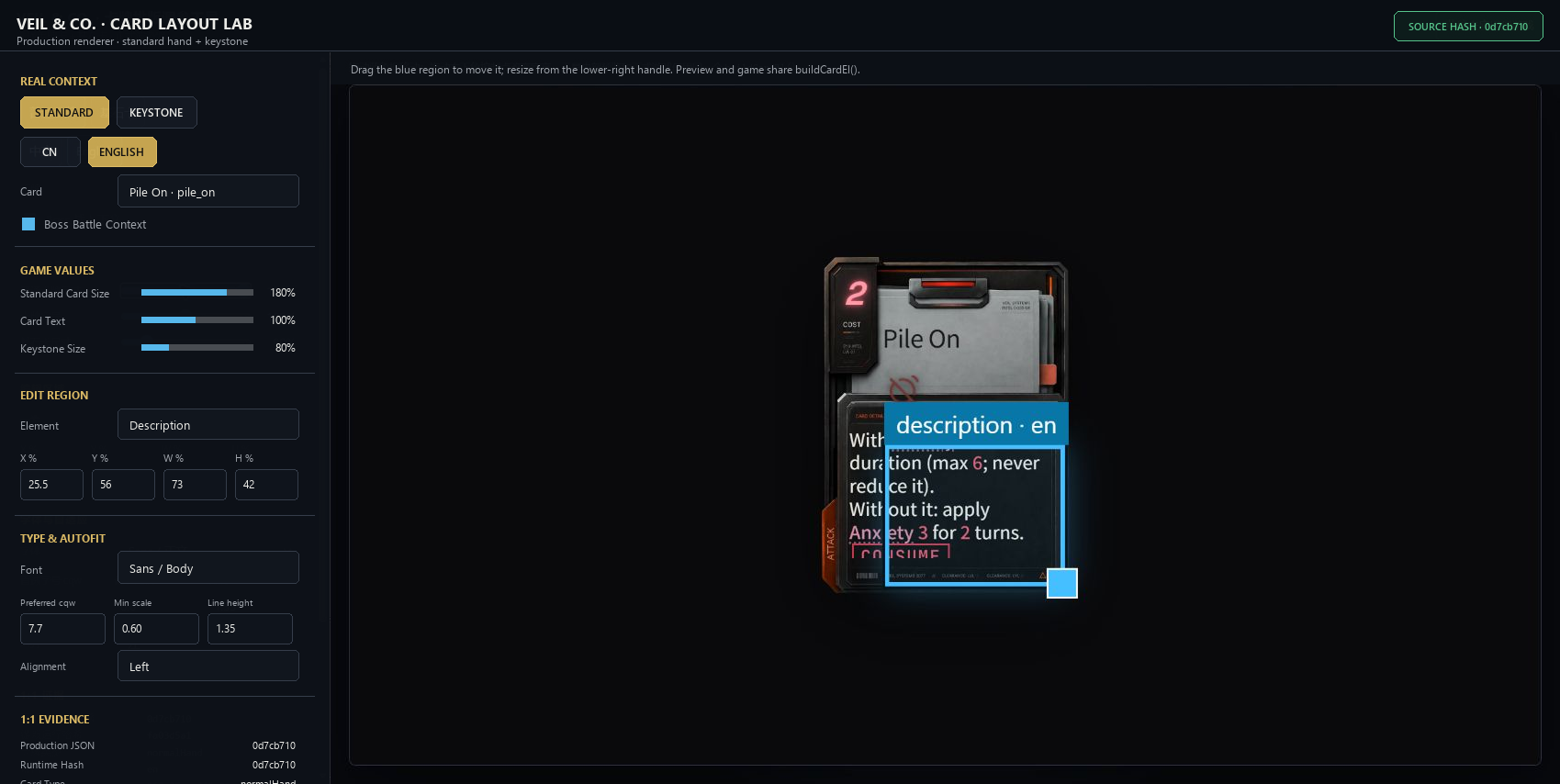
SEVEIL card layout adjustment tool

Card Layout Lab

Previewed composition, text density, hierarchy, and content variations before cards entered the playable build.

TOOL 02
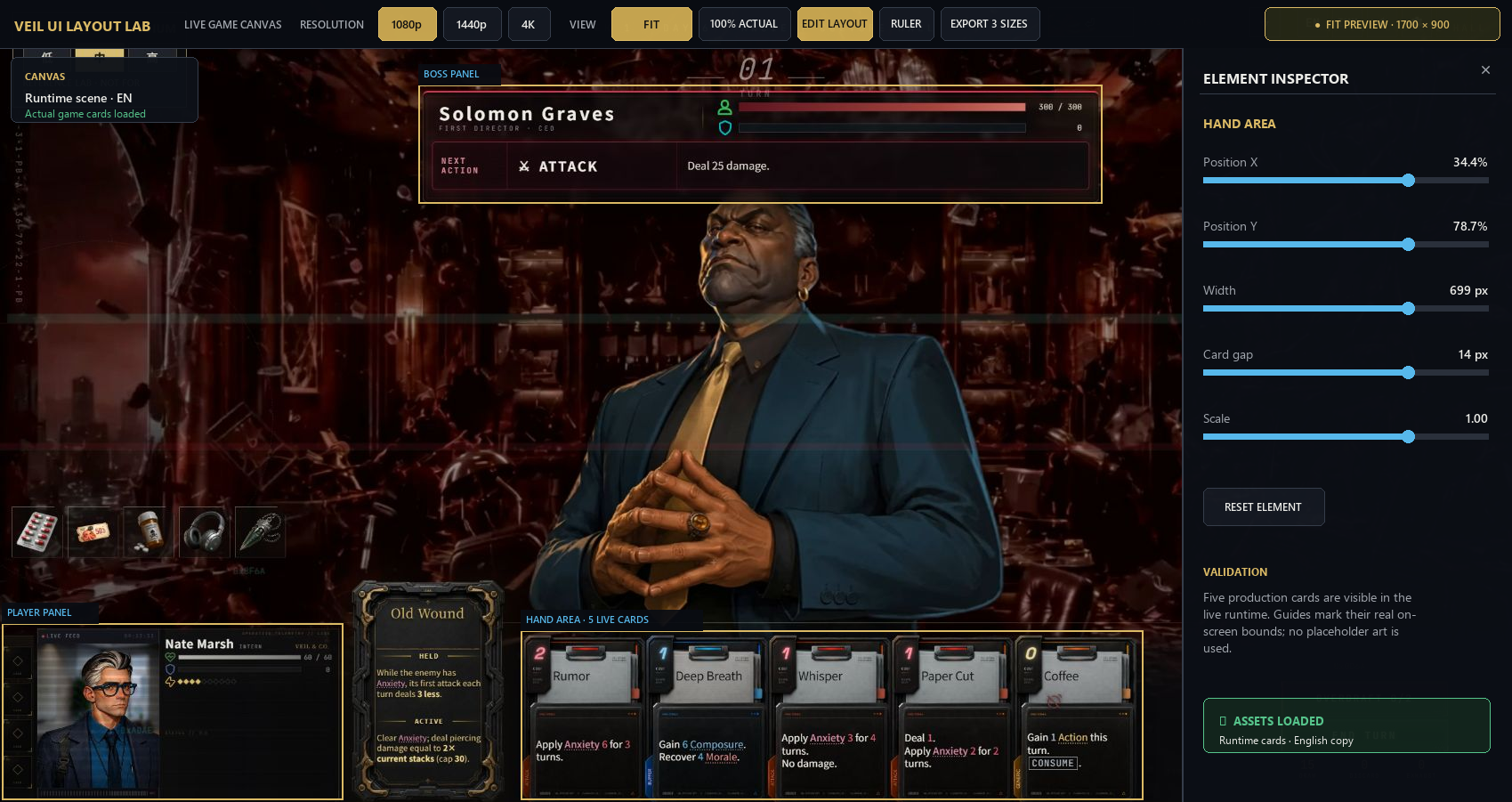
SEVEIL UI alignment and resolution inspection tool with measurement grid

UI Alignment & Resolution Inspector

Checked spacing, safe areas, alignment, and interface behavior across nine target aspect ratios.

TOOL 03
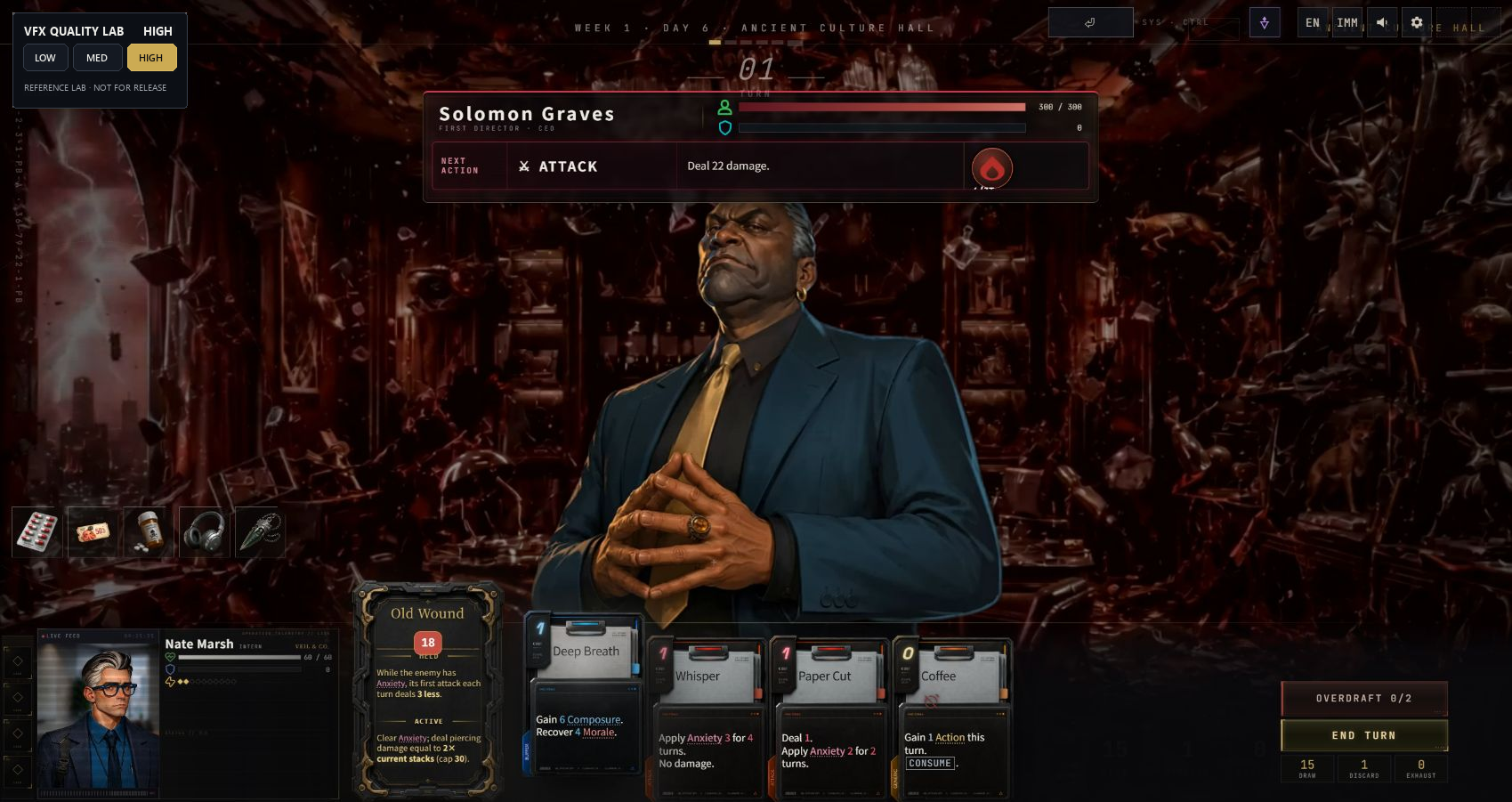
SEVEIL keystone card VFX preview tool during an effect test

Three-Tier VFX Preview Lab

Compared low, medium, and high effect intensity outside combat for readability, impact, and performance.

TOOL 04
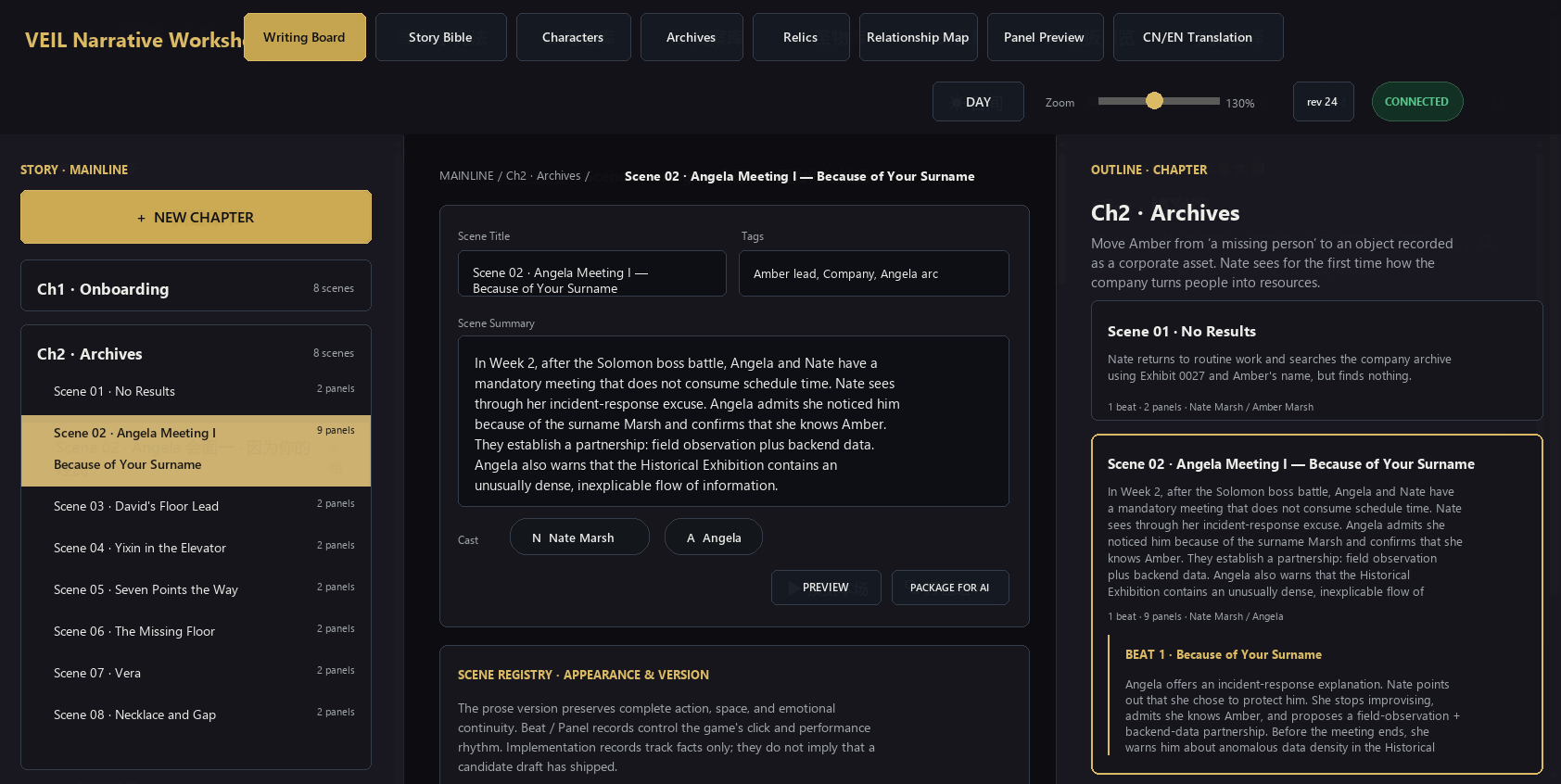
VEIL narrative workshop interface and its writing modules

Narrative Workshop

Structured character voice, dialogue, event writing, revisions, and localization handoffs without editing production data by hand.

Production infrastructure
Batch image pipelineProduction
Extensible content pipelineScalable
Automated tests & release gatesVerified
AI handoff memoryContinuous
DesignPreviewCompareVerifyShip
QUALITY GATES BROWSER MASTER GATE 24/24 LETTERBOX CONTRACT 22/22 ASPECT RATIOS CLICK-VERIFIED 9 FIRST PAINT (1080P COLD) ~341 MS MEDIA FILES HASH-VERIFIED 386/386
The Film

Two minutes, the whole story.

SEVEIL — how one artist shipped a real game with AI
▶ PLAY — 2:15
05 · Why It Matters

What this project demonstrates.

An AI-native art director

A director who turns AI into reliable production capacity while personally holding the quality bar across art, engineering, and narrative.

Full-pipeline ownership

Concept, characters, environments, UI systems, game design, narrative, marketing assets and store copy — one coherent vision carried from first sketch to playable, distributable builds.

Production discipline

Frozen baselines, scoped branches, gated releases and clean handoffs — the habits of someone who has led teams for years, applied to a new kind of team.

We weave your dreams